In Today’s book talk, I am going to discuss about my book “Five simple grafting techniques best suited for most exotic fruit plants”.
Showing posts with label exotic fruits. Show all posts
Showing posts with label exotic fruits. Show all posts
Tuesday, May 28, 2019
BookTalk: Five simple grafting techniques
In Today’s book talk, I am going to discuss about my book “Five simple grafting techniques best suited for most exotic fruit plants”.

Saturday, February 11, 2017
From Eden Gardens to God’s dining table! 😄
When I visited one of the Indian Hindu temples in California,
I was given a ‘prasad’ (a portion of
the food offered to the God), which was a bit of surprise to me. Normally the prasad distributed in India are sweets.
But this prasad was spicy/sour and made of rice! It is called tamarind rice
(called Puliogare in South India).
I wondered how the Hindu Gods developed a taste for this
spicy rice! Actually, tamarind is such an essential ingredient in South Indian
cuisine that a typical South Indian cannot think of cooking without tamarind!

But plant historians say that tamarind is not from
India, but from Africa. They say that tamarind was known even before 500 B.C.
in Egypt.
It is believed that humans evolved from Africa. So is tamarind from Eden gardens where the Gods are supposed to have created Adam and Eve?! Probably that explains why it is God's favorite 😄
Do you know something? The very name tamarind comes from the Arab word ‘tamar hindi’ meaning Indian dates! The flesh resembles dates and
there is even a sweet variety that tastes almost like dates. Even the botanical
name Tamarindus indica suggests that the fruit is from India! Does it mean
that the fruit moved straight from Eden Gardens to God’s dining table in
India??? 😄 😄
Saturday, February 4, 2017
Fruits straight from Indian epic Ramayana!
Indians have such fascination for their great epic namely Ramayana that they see the epic
characters live in almost everything!
They even have named a family of fruits each after some
prominent character from Ramayana.
For example, they have Ram Phal
(named after the hero Ram, Phal means
fruit), Laxman Phal (named after the
second hero), Seetha Phal (named
after the heroine), Hanuman Phal
(named after their most obedient companion). I always wondered what likeness Seetha Phal has with the heroine! Or for
that matter Hanuman Phal with the
character Hanuman (who has a monkey
like appearance).
But as always, there is whole lot of confusion. Indians use
these names interchangeably to mean different fruits in the group or the same
fruit. Most laymen call all these fruits as just Seetha Phal!
 Actually these fruits are fruits belonging to the same family
ANNONACEAE. Ram Phal is the Custard Apple (Annona
Reticulata),
Laxman Phal is Atemoya (a man made cross between Annona Squamosa
and Annona Cherimola), Seetha Phal is Sugar Apple (Annona
Squamosa) and Hanuman Phal is Cherimoya (Annona Cherimola).
Actually these fruits are fruits belonging to the same family
ANNONACEAE. Ram Phal is the Custard Apple (Annona
Reticulata),
Laxman Phal is Atemoya (a man made cross between Annona Squamosa
and Annona Cherimola), Seetha Phal is Sugar Apple (Annona
Squamosa) and Hanuman Phal is Cherimoya (Annona Cherimola).
There is
another member in this family that has recently become very prized one. A few
years ago, there were no takers for this fruit (it is a bit sour), But
recently, on rumors (?) that this fruit can cure/prevent cancer, overnight this
fruit has become the most sought after fruit in India. This fruit is called by
different names, Hanuman Phal, Laxman Phal, Mam Phal by
Indians. Actually it is Sour Sop (Annona Muricata)
The
interesting thing is that none of these fruits are originally from India (as
per the plant historians). But what is more interesting is that in some Indian
languages, say for example Konkani (a language spoken in Goa – a former
Portuguese province, now in India), Andana (sounds like Annona) refers
to either Seetha Phal or one of the fruits in this family. Also, I
remember seeing this fruit carved in ancient Hindu temples like Ellora cave
temples. So, did Seetha actually invent this fruit? – I am just kidding.
Saturday, January 28, 2017
Sexy fruits!
I am not talking about any aphrodisiac fruit but only about
fruit trees that exhibit varieties of sexual behavior.
Gender galore: While many wild fruit trees (also
some cultivated) have male and female flowers in separate trees, some like
Papaya are really sexy! Some varieties of Papaya bear male, female,
male-female, neither completely male nor completely female flowers either on
the same tree or on different trees.
Occasional sex changers: Some papaya trees even
change sex depending on weather conditions. A male tree becomes female and vice
versa depending on weather! What is more – if you behead a male papaya tree
(males don’t produce useful fruits), chances are that it would become female
when new shoots grow from the stump! They say that if there is a lone male
papaya tree with no female tree in the vicinity, it automatically becomes
female! – But I am not sure about this last one.
Habitual sex changers: There are fruit trees such as
Sugar apple (and others in the family) and Avocado, that have the habit of
changing sex every now and then! A sugar apple flower which is otherwise
bisexual acts like female for few hours and changes into a male the next day!
Similar thing happens in Avocado. So if all flowers decide to change to same
sex same time, there is no way you can expect any fruits from that tree!
Some need help: Some fruits such as Cherimoya
cannot pollinate on their own. They need human intervention – manual
pollination.
No to consanguineous
unions: It is not just humans; even fruit
trees such as some varieties of Apples, Avocado, and so on shun consanguineous
unions. To bear fruit, you need at least two different varieties in the same
garden, even if trees bear bisexual flowers. Some are even choosier. They need
a specific variety for cross pollination!
If you ponder over why all these
gimmicks, you probably understand the complete philosophy behind union and
procreation.
Saturday, January 21, 2017
Fruit first or flower first?
No, it is not yet another chicken and egg paradox. Normally a
flower appears first and then the flower turns into a fruit. But not so in fig
and other fig relatives. Many Indian folklores tell you that no one can ever
see flowers of a fig tree suggesting that it is actually a miracle tree –
bearing fruits without flowers!

Actually, fig trees do put off flowers, but inside the fruit!
What you call as fig is actually not a fruit but only a receptacle that
encloses the flowers inside.
This receptacle has a one-way (?) hole at the bottom
that allows pollinating insects to enter in. They enter, pollinate the flowers
and even lay eggs inside.
But unfortunately they may get trapped inside since they cannot
come out! They finally die and get absorbed in the fruit itself (vegetarians
among you may find it a bit nauseating – but don’t worry it is too small to
notice!).
In due course, the eggs laid by the insect hatch and the worms
come out. That is why you sometimes see worms inside figs and other related
fruits. But not all fig flowers get pollinated and so the tiny seeds that are
formed will normally be hollow shells.
Saturday, January 14, 2017
Fruit wonders
In previous posts we discussed varieties of issues. For another couple of posts I will write some interesting facts about fruits. I just love fruits and more than eating them, I am fascinated by fruit marvels!.
Fruit that is not a fruit!
I am not posing a riddle. Some of you who are fruit savvy
might have guessed. Yes, I am talking about cashew. Did you know that cashew is
not actually a fruit? What we call as cashew nut is the actual fruit and the so
called cashew apple is just the stem of the fruit that becomes plump and juicy!
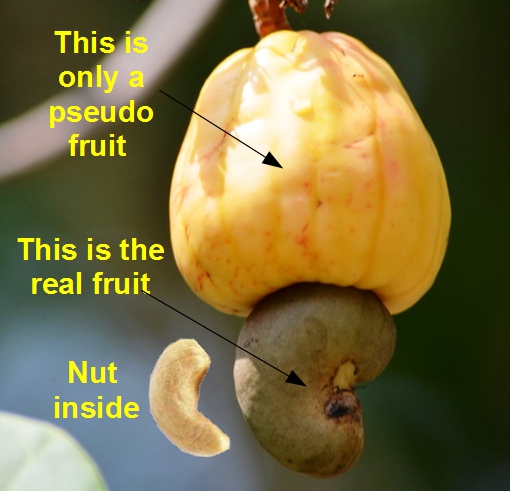 Cashew is supposedly from South America spread by Portuguese to
other parts of the world especially to India where today it supports a big
industry – cashew nut industry. But it is called ‘Kaaju’ in many Indian
languages as it is in Portuguese. I wonder whether Portuguese brought it to
India or took it from India! There are at least two other related species wild
in India, that are also recognized as cashew in some of the local Indian
languages.
Cashew is supposedly from South America spread by Portuguese to
other parts of the world especially to India where today it supports a big
industry – cashew nut industry. But it is called ‘Kaaju’ in many Indian
languages as it is in Portuguese. I wonder whether Portuguese brought it to
India or took it from India! There are at least two other related species wild
in India, that are also recognized as cashew in some of the local Indian
languages.
What is interesting is that originally the trees were planted
neither for fruits nor the nuts but to prevent soil erosion on the coasts. In
some South American countries the nuts were just thrown away and only the
cashew apples were eaten or fermented to make wine. It was probably the Indians
who found the ingenious technique to peel off the husk - that oozes corrosive
juice - to take out the tasty and prized nuts. And today cashew nut industry is
a major industry in India. Unfortunately, in contrast to their South American
counterparts, the cashew apples are mostly discarded in India! Of course, in
coastal Indian state of Goa they make a popular wine called Feni from these apples.
Subscribe to:
Posts (Atom)